Menu
4.9
2067 reviews
Laguna Hills Diabetic Retinopathy
Laguna Hills Proliferative & Non-Proliferative Diabetic Retinopathy
Diabetic retinopathy is a condition where high blood sugars damage the blood vessels in the retina (the retina is the layer of cells in the back of the eye that transmit light to the brain to form images). There are two main types of diabetic retinopathy: non-proliferative diabetic retinopathy (NPDR) and proliferative diabetic retinopathy (PDR).
- Non-Proliferative Diabetic Retinopathy: Among the first signs of diabetic retinopathy are microaneurysms, which are small red “blood dots” or hemorrhages that indicate pouches in the retinal capillaries and arteries (small blood vessels). These pouches leak serum or fluid from the bloodstream into the retina called exudates, which may cause it to swell. This swelling of the retina is known as macular edema. As retinopathy progresses, white spots in the retina, known as cotton-wool spots, may also develop which suggests lack of oxygen or blood flow. The swelling of the macula (diabetic macular edema) is the most common reason a patient with Diabetes will notice blurred central vision. Vision loss can range from mild to severe because of diabetic macular edema (DME).
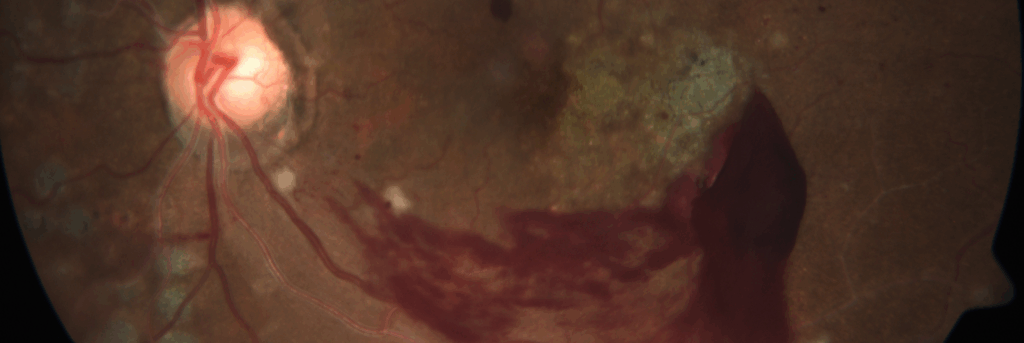
- Proliferative Diabetic Retinopathy: In some patients, diabetic retinopathy may progress from non-proliferative to proliferative. Proliferative diabetic retinopathy is characterized by neovascularization (neo = “new” and vascularization = “blood vessels”). That is, the appearance of new, fragile blood vessels on the optic nerve or retina’s surface. These new blood vessels frequently bleed into the vitreous cavity, causing hemorrhage. Furthermore, they may cause scarring on the retina, which can pull the retina, causing tractional retinal detachment. These new blood vessels are like “weeds in the garden” and may even grow in the front of the eye on the iris, causing a severe type of glaucoma to develop.
What are the warning symptoms of Laguna Hills Diabetic Retinopathy
Often those diagnosed with diabetic retinopathy have normal vision, particularly when there is no diabetic macular edema, vitreous hemorrhage or tractional retinal detachment. This is precisely why regular eye examinations are important and can yield the most effective treatment because early detection is extremely vital.
When patients do exhibit symptoms, they often begin with blurred vision. Patients may also begin to see floaters, which may be signs of a vitreous hemorrhage.
What are the causes of Laguna Hills diabetic retinopathy?
Generally, diabetic retinopathy is caused by damage to the retinal blood vessels as a result of elevated sugar (glucose) levels in the bloodstream. Chronic elevated glucose levels may damage normal retinal blood vessels, causing them to leak fluid or create small hemorrhages in the retina. In more advanced stages, the retinal blood vessels can become blocked, restricting the retina’s oxygen levels. As a reaction to this, the retina grows new blood vessels or neovascularization.
What is the treatment for Laguna Hills diabetic retinopathy?
The first measure of treatment in diabetic retinopathy is to control blood glucose levels. This will not prevent or reverse diabetic retinopathy, but tends to slow its progress. Doctors can use laser photocoagulation to treat macular edema, placing small burns around the retina’s center, known as the macula. Alternately, doctors may inject drugs such as ranibizumab (Lucentis), bevacizumab (Avastin), aflibercept (Eylea) or steroids into the eye, in a treatment known as an intravitreal injection. Similar to the pills or Insulin that is necessary to manage one’s diabetes, these injections may be necessary to manage the complications of the disease for years to come.
Doctors and patients can determine the most suitable treatment methods based on the patient’s severity and the macular edema’s precise location. Often, intravitreal injections must be repeated in order to control the macular edema. Proliferative diabetic retinopathy is generally treated with laser photocoagulation, where laser burns are placed in the peripheral retina, but can also be augmented with intravitreal injections. This treatment creates a lower oxygen demand for the retina, either reducing or totally resolving retinal and optic nerve neovascularization. Both forms of treatment can be performed in an office setting.
In cases of vitreous hemorrhages or traction retinal detachment, a patient may require a surgical procedure known as vitrectomy. Unlike intravitreal injections or laser photocoagulation, vitrectomy is performed in an operating room.
In treating diabetic retinopathy, early detection is imperative. Treatment is much easier and less invasive in the earlier stages and timely treatment of diabetic retinopathy is the best way to guard against progressive vision loss. Although keeping one’s blood sugars under control does not guarantee good vision, it can reduce the risk of blindness compared to those patients who don’t control their blood sugars.
Contact Our Laguna Hills Retina Doctors Today
If you have diabetes, it’s important to have your pupils dilated by an eye care professional and if diabetic retinopathy is diagnosed, seeing a retina specialist can be important in the prevention of further vision loss. Contact the Retina Associates of Orange County to schedule your appointment today.
Posted on Google![]()
Jackie Curry2 days agoTrustindex verifies that the original source of the review is Google.
Quick and thorough!Posted on Google![]()
Colleen Casciari3 days agoTrustindex verifies that the original source of the review is Google.
After arriving for my appointment & checking in there was very little waiting. The staff was efficient and very pleasant. My doctor answered all my questions and concerns.Posted on Google![]()
donna Anderson3 days agoTrustindex verifies that the original source of the review is Google.
Dr McGuire was so nice and reassuring. Answered all my questions. Great Doctor!Posted on Google![]()
Vijay Desai3 days agoTrustindex verifies that the original source of the review is Google.
I would like to share my experience with Dr. Desmond Edward McGuire, a Retina Specialist, who has been treating my mom for macular degeneration in both eyes for the past 8–10 years. We have consistently found him to be an excellent doctor, very knowledgeable, caring, and attentive to her needs. We also want to recognize how nice and helpful the staff is. On most visits, we hardly ever have to wait and the appointment is typically completed within about 30 minutes. Overall, the experience has been very smooth and reassuring for our family. We truly appreciate Dr. McGuire and the entire team for their support and professionalism over the years.Posted on Google![]()
Eddie H.3 days agoTrustindex verifies that the original source of the review is Google.
Dr Charles Eifrig has been my retina dr for many years now and is always very patient with the questions I have and answers everything while also addressing my concerns. I am grateful to be in his care. His office is also very efficient. Thank you to him and his staff/officePosted on Google![]()
Alan Worrell3 days agoTrustindex verifies that the original source of the review is Google.
Friendly, professional, knowledgeable, informative. The best office and technical support staff I've ever encountered.Posted on Google![]()
Charles Davis3 days agoTrustindex verifies that the original source of the review is Google.
Dr Eifrig is an excellent physician. Personable, professional, and thoroughly competent. In fact - expert.Posted on Google![]()
Annette Stankovich3 days agoTrustindex verifies that the original source of the review is Google.
She is very knowable and makes me feel valued.Posted on Google![]()
ron green3 days agoTrustindex verifies that the original source of the review is Google.
Very professionalPosted on Google![]()
emily guichet4 days agoTrustindex verifies that the original source of the review is Google.
Excellent care. Very courteous.