
Call Us Today!
(949) 707-5125
Menu


Retina Associates of Orange County has treated wet AMD patients across California for more than two decades. Our physicians specialize in the medical and surgical treatment of retinal disease, and we use advanced diagnostic imaging and proven injection therapies to slow or stop the progression of wet macular degeneration. Early detection changes outcomes. If you’re noticing changes in your central vision, schedule an appointment with our California wet macular degeneration doctor.
Dr. Desmond Edward McGuire, M.D. completed his medical training at the Sackler School of Medicine at Tel Aviv University, followed by an internship at Columbia University College of Physicians and Surgeons at St. Luke’s-Roosevelt Hospital in New York. He completed his ophthalmology residency at St. Vincent’s Hospital and Medical Center in New York, then pursued a fellowship in vitreoretinal surgery at the Shiley Eye Center at the University of California, San Diego. That fellowship is where retina doctors develop the specialized skill set required to treat conditions like wet macular degeneration, diabetic retinopathy, and retinal detachment.
Our physicians bring 23 years of experience treating retinal conditions to every patient interaction. As a California retina specialist practice, we focus exclusively on diseases of the retina and vitreous, which means wet AMD treatment is a core part of what we do every day.
Wet macular degeneration requires precise imaging to monitor disease activity. We use optical coherence tomography (OCT) and fluorescein angiography to visualize the abnormal blood vessels beneath the retina that define wet AMD. These tools let us see fluid leakage, track treatment response, and make real-time adjustments to your care plan. Our California optical coherence tomography capabilities allow us to identify structural changes in the macula at the micron level.
Dr. McGuire is a member of the American Academy of Ophthalmology, the American Society of Retina Specialists, the Orange County Society of Ophthalmology, the Orange County Medical Association, and is certified by the American Board of Ophthalmology. These affiliations reflect ongoing commitment to evidence-based retinal care and continuing education in a field where treatment options evolve rapidly.
⭐⭐⭐⭐⭐
“Dr. Gupta and her team are excellent. They are efficient, professional, and friendly. They take the time to explain their services, and the doctor conveys her medical knowledge with a compassion. Also, it’s worth mentioning that the medical facility, The Taj Mahal building, housing her office is quite remarkable.” — Liz French
Read more reviews on our Google Business Profile.
Our practice is focused entirely on retinal and vitreous diseases. We treat a range of conditions that can threaten vision, and many of them share risk factors or occur alongside wet AMD.
California has several statutes and regulatory frameworks that affect how patients access retinal care and cover the cost of treatment for conditions like wet AMD.
The California Department of Managed Health Care oversees HMO plans and requires that enrollees have access to specialists, including retina doctors, without unreasonable delay. Under California Health & Safety Code provisions governing timely access, health plans must provide appointments with specialists within 15 business days of a request. For urgent conditions like active wet macular degeneration, that timeline compresses further. Patients who experience barriers to specialist referrals can file complaints through the DMHC’s Help Center.
Medicare covers anti-VEGF injections for wet AMD under Part B as physician-administered drugs. According to the Centers for Medicare & Medicaid Services, beneficiaries pay 20% coinsurance after meeting their deductible for these treatments, which are administered in-office. The CDC’s Vision and Eye Health Surveillance System estimates that nearly 20 million Americans live with some form of AMD, and late-stage disease affects approximately 1.49 million individuals.
California’s Department of Insurance regulates PPO and indemnity plans separately from HMOs, and patients in those plans should verify their retinal care coverage directly with their insurer.
Anti-VEGF drugs are the standard of care for wet AMD. The National Eye Institute confirms that these medications block vascular endothelial growth factor, the protein responsible for triggering abnormal blood vessel growth beneath the retina. Medications like aflibercept, ranibizumab, and faricimab are injected directly into the vitreous cavity of the eye under local anesthesia. The procedure takes minutes. Most patients need a series of monthly injections initially, followed by a maintenance schedule based on how the eye responds. Some patients eventually extend their treatment intervals to every 8, 12, or even 16 weeks.
Wet AMD doesn’t follow a predictable course. Some patients stabilize quickly. Others experience recurrent fluid leakage that requires close monitoring and treatment adjustments. OCT imaging at each visit tracks macular thickness and fluid levels. Changes in these measurements guide treatment decisions, and missing follow-up appointments creates real risk of irreversible vision loss. Our follow-up care protocols are built around consistent retinal imaging and individualized treatment planning.
The warning signs of retinal problems with wet AMD often appear suddenly. Metamorphopsia, where straight lines appear distorted, is one of the most common early symptoms. Other patients notice a gray or blank spot in their central vision, or colors that seem faded. An Amsler grid test at home can help detect early changes between office visits, but it’s not a substitute for regular dilated exams with a retina specialist.
Not all macular degeneration is the same. Dry AMD involves the gradual breakdown of light-sensitive cells in the macula and the accumulation of deposits called drusen. It progresses slowly, often over years. Wet AMD occurs when abnormal blood vessels grow beneath the retina, leak fluid, and scar the tissue. Roughly 10 to 15% of all AMD cases are wet, but the wet form causes the majority of severe vision loss associated with macular degeneration. Knowing whether you have the wet or dry form determines your entire treatment path.
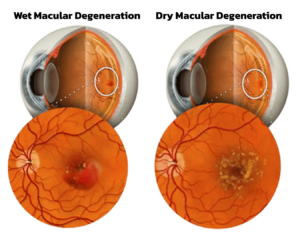
Wet AMD is a chronic condition. Treatment can stabilize or even improve vision, but it rarely eliminates the underlying disease process entirely. Patients need ongoing monitoring even after active leakage resolves, because recurrence is common. Maintaining consistent appointments with a wet macular degeneration doctor in California who specializes in retinal disease is the most effective way to protect your remaining vision over time. The practice also participates in clinical research through the Retina Associates Research Institute, which gives eligible patients access to investigational therapies before they’re widely available.
If you’re experiencing sudden changes in your central vision, distorted lines, or new dark spots, those symptoms warrant evaluation by a retina specialist who treats wet macular degeneration in California. We diagnose and manage all stages of AMD using the latest imaging and treatment technologies.
Our practice has multiple locations across Orange County to make appointments accessible. Contact us to schedule an evaluation. Early treatment of wet AMD produces better visual outcomes, and our physicians are available to see patients promptly when symptoms are active.
We are dedicated to delivering compassionate, expert care to patients facing sight-threatening retinal conditions.


