
Call Us Today!
(949) 707-5125
Menu


If an eye doctor recently found drusen during a routine exam, or mentioned the words “macular degeneration,” you may have questions. Dry age-related macular degeneration is the most common form of AMD, accounting for roughly 85% of all cases, and it doesn’t always cause noticeable symptoms in its early stages. That’s part of what makes it so important to monitor.
Dry AMD has stages. Early and intermediate dry AMD may produce no symptoms at all, or only mild difficulty reading in low light. But the late stage, called geographic atrophy, causes permanent cell death in the retina and progressive loss of central vision. Retina Associates of Orange County has been diagnosing and managing dry macular degeneration across California for over 23 years. Our California dry macular degeneration doctor focuses exclusively on diseases of the retina and vitreous, and we use the latest imaging and treatment options to help patients preserve their remaining sight. If you’ve been diagnosed with any stage of AMD, schedule a retinal evaluation.
Our physicians completed fellowship training specifically in vitreoretinal disease and surgery. Dr. Desmond Edward McGuire, M.D. earned his medical degree from the Sackler School of Medicine at Tel Aviv University. He trained in internal medicine at Columbia University’s St. Luke’s-Roosevelt Hospital and completed his ophthalmology residency at St. Vincent’s Hospital and Medical Center in New York. His vitreoretinal fellowship at the Shiley Eye Center, University of California, San Diego, provided intensive training in diagnosing and managing complex retinal conditions, including all stages of macular degeneration.
That level of subspecialty training matters when you’re dealing with a progressive condition like dry AMD. General ophthalmologists see a broad range of eye conditions. Retina specialists see the retina all day, every day. Dr. McGuire is board-certified by the American Board of Ophthalmology and is a member of the American Academy of Ophthalmology and the American Society of Retina Specialists, along with the Orange County Society of Ophthalmology and the Orange County Medical Association. Our physicians as a group bring more than two decades of focused retinal practice to every case we evaluate.
For years, there were no approved therapies for dry AMD. That changed in 2023 when the FDA approved two complement inhibitor drugs, Syfovre (pegcetacoplan) and Izervay (avacincaptad pegol), for treating geographic atrophy. These medications work by targeting overactive proteins in the complement immune pathway that contribute to retinal cell death. As a California Izervay retina specialist and Syfovre specialist practice, we administer both of these treatments and help patients determine whether they’re appropriate candidates based on the stage and location of their geographic atrophy.
We also participate in research through the Retina Associates Research Institute, which gives eligible patients the opportunity to access investigational therapies before they become widely available.
⭐⭐⭐⭐⭐
“Very well organized! The organization works exceptionally as a team! Dr Gupta does an excellent job explaining everything to you. She is caring and very thorough! Excellent !!!” — John Nelson
Read more reviews on our Google Business Profile.
Dry macular degeneration often coexists with other retinal conditions, or shares risk factors with them. Our practice treats the full spectrum of retinal disease.
Several California and federal frameworks shape how patients access and pay for retinal care, including treatment for dry macular degeneration.
The California Department of Managed Health Care regulates HMO plans and enforces timely access standards. Under state rules, patients must be offered specialist appointments within 15 business days. Patients experiencing vision changes that could signal AMD progression should request urgent referrals and can file complaints with the DMHC if access is delayed.
Medicare Part B covers medically necessary retinal evaluations and in-office procedures, including OCT imaging and intravitreal injections for geographic atrophy. Beneficiaries are responsible for 20% coinsurance after meeting their annual deductible. The Centers for Medicare & Medicaid Services website has plan-specific details. Data from the CDC’s Vision and Eye Health Surveillance System estimates that roughly 18.34 million Americans over age 40 had early-stage AMD in 2019, and 1.49 million had late-stage disease.
The National Eye Institute provides patient education materials on AMD stages, risk factors, and the AREDS2 supplement formula, and the California Department of Insurance oversees PPO and indemnity plans for patients not enrolled in managed care.
Dry macular degeneration isn’t a single condition. It’s a spectrum. In the early stage, small drusen deposits form beneath the retina. Most patients have no symptoms at this point, and the condition is often found incidentally during a dilated eye exam. Intermediate dry AMD involves larger or more numerous drusen, and some patients begin noticing difficulty adapting to low-light environments or subtle changes in central vision. How your retina changes with aging determines how quickly you move through these stages.
Late-stage dry AMD is geographic atrophy. At that point, cells in the retinal pigment epithelium and the overlying photoreceptors begin dying in well-defined patches. These patches expand outward over months and years, and once they reach the fovea, the center of sharpest vision, patients experience noticeable central vision loss.
The National Eye Institute’s Age-Related Eye Disease Studies established that a specific formula of antioxidant vitamins and minerals can slow progression from intermediate to late-stage AMD. The AREDS2 supplement formula contains vitamin C, vitamin E, lutein, zeaxanthin, zinc, and copper. A 2024 NEI analysis found that these supplements may also slow geographic atrophy expansion, particularly when the atrophy starts outside the fovea. Patients with early-stage dry AMD typically do not need AREDS2 supplementation, but those with intermediate disease in one or both eyes often benefit. Your dry macular degeneration doctor in California can help you determine whether supplementation is appropriate based on your imaging findings.
Until 2023, geographic atrophy had no FDA-approved treatments. That changed with the approval of two complement inhibitor drugs. These medications target specific proteins in the complement cascade, a part of the immune system that, when overactive, accelerates retinal cell death. Clinical trials showed that regular injections of these drugs slowed the rate of GA lesion growth. Neither drug reverses existing damage, and they don’t work for early or intermediate dry AMD. But for patients with diagnosed geographic atrophy, they represent the first real pharmacologic option to slow the disease. Our California geographic atrophy specialists evaluate every GA patient for treatment candidacy.
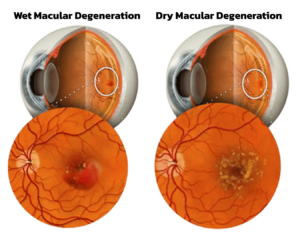
Any stage of dry AMD can convert to wet macular degeneration. When that happens, abnormal blood vessels grow beneath the retina and begin leaking fluid or blood. This conversion can be sudden and requires different treatment. We monitor dry AMD patients with regular OCT imaging and dilated exams. At home, patients can use an Amsler grid to check for early distortion between visits. The signs of retinal problems that should prompt an urgent call include sudden blurriness, new distortion of straight lines, or a dark spot appearing in central vision.
Age is the primary risk factor for dry macular degeneration. The condition most commonly affects people over 50, and prevalence rises sharply after age 70. Smoking is the largest modifiable risk factor. Light-colored eyes, a family history of AMD, cardiovascular disease, and diets low in leafy green vegetables also increase risk. There’s no guaranteed way to prevent dry AMD, but quitting smoking, maintaining healthy blood pressure, wearing UV-protective sunglasses, and eating a nutrient-rich diet all reduce the odds of progression. Regular dilated eye exams catch changes early, which is when intervention options are broadest.
If you’ve been diagnosed with dry macular degeneration, or if a routine eye exam revealed drusen deposits, a retina specialist can assess your stage and discuss your monitoring and treatment options. We see patients across California from our Orange County locations.
Contact us to schedule a retinal evaluation. Whether you need baseline imaging, AREDS2 counseling, or an assessment for geographic atrophy treatment, we’re here to help protect your vision at every stage.
We are dedicated to delivering compassionate, expert care to patients facing sight-threatening retinal conditions.